Fire on the Mountain
New Mexico
Fire on the Mountain’s campaign goal: move the radioactive waste at LANL to safer storage at WIPP before the next wildfire threatens it and us. Persuade the governor to use New Mexico’s legal tools to force DOE to move it as promised.
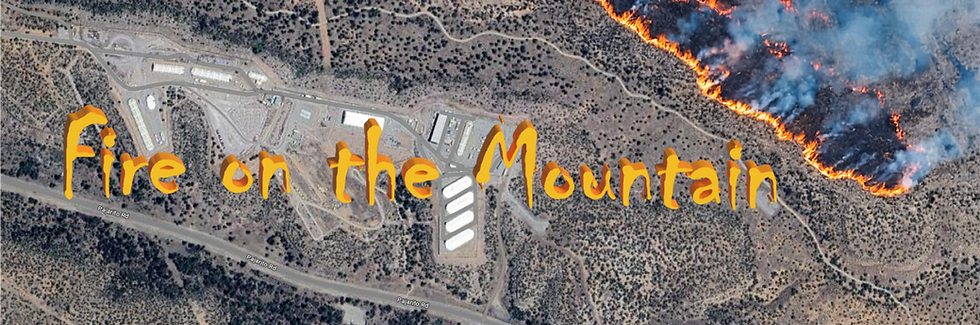
*This image is an artist's conception of a wildfire near the actual waste storage tents at LANL.
Fire on the Mountain Videos
The Problem – How Plutonium Affects a Community – The Solution
On Earth Day this past April Cindy Weehler gave a presentation on the problem of nuclear weapons waste stored on the mountainside at LANL, how plutonium affects the community, and the solution to the problem.
Part 1: The Problem
Nuclear waste is stored at LANL, unprotected, in a wildfire zone.

FOTM_Part_01-Video-The_Problem
Part 2: How Plutonium Affects a Community
Plutonium vaporized in a fire affects your health and property. We can choose to forget about nuclear waste, but it doesn’t forget about us.

FOTM_Part_02-Video-Affects_of_Plutonium
Part 3: The Solution
If a disaster is so bad that it cannot be fixed, the solution is to not let it happen.

FOTM_Part_03-Video-The_Solution
What Happened on February 11 and What It Means
On February 11, the New Mexico Environment Department (NMED) issued a press release stating that it is finally taking action against the Department of Energy (DOE) for failing to cleanup legacy waste at LANL. As you know, DOE ignores the permit and says it will take decades to move it.
In a huge first step, NMED and the governor said publicly that DOE is out of compliance. In their frustration, they restated their legal authority:
NMED has authority under the permit to modify, suspend, or revoke hazardous waste permits to protect human health and the environment and reserves the right to pursue other courses of action.
Not only did NMED reclaim its authority, the agency described the steps it can take to force DOE into compliance.
Modify the permit
In an almost unprecedented move, NMED will modify the permit by changing the vague wording in the permit from “prioritizing LANL legacy waste” over other waste going to WIPP, to specific metrics that can be measured. These observable metrics will have to show how much waste DOE is moving to WIPP over time until it is all in WIPP.
Suspend the permit
NMED can suspend the permit that allows DOE to operate WIPP if it doesn’t comply. This could include NMED not allowing DOE to use WIPP to emplace waste other than LANL legacy waste until it has removed all of it from the lab.
Revoke the permit
The final action can be revocation of the permit entirely. This action can be used as a threat to motivate DOE to solve this dangerous situation.
Please thank the governor and NMED Secretary Kenney for this first step.
But the legacy waste is still in a wildfire zone at LANL. Nothing is safe yet, and it won’t be until the waste is all in WIPP. NMED must follow through by:
-
including the public and NGOs in rewriting the permit,
-
rigorously tracking DOE's actions, and
-
penalizing DOE as appropriate if it fails.
We are the ones who must monitor NMED! We are concerned that the state won’t use the penalties that motivate the feds the most. It will take courage for New Mexico to stand up to the federal DOE. Failure to use the appropriate penalty could doom the mission.
We need to—
-
Keep the pressure on NMED and the governor, thanking them when they succeed.
-
Keep pressure on candidates for governor before and after they attain office.
-
Make more members of the public aware of this issue.
Remember this is winnable, we’re so much closer now because of your actions, and your actions are still needed.
Legacy Waste at LANL Gets National Attention
The New York Times recently published Alicia Inez Guzman’s article about the unsafe storage of Cold War waste at LANL! Guzman is an investigative journalist from New Mexico. We can’t reprint it because of copyright issues, but you can access it here:
https://www.nytimes.com/2026/02/11/us/new-mexico-los-alamos-nuclear-waste-fines.html?login=email&auth=login-email
In her article, "New Mexico Rebukes Federal Agency Over Nuclear Waste at Los Alamos," Ms. Guzman details how the federal Department of Energy (DOE) has used New Mexico for over half a century to create, detonate, and store the waste from nuclear bombs. The new story is that New Mexico’s Environment Department (NMED) has decided to insist that DOE manage this waste safely, instead of mishandling it as it historically has. The governor is listening to the NMED, and we hope changes are in progress.
What are the changes? New Mexico is fining DOE $16 million, which isn’t as much of a sanction as it seems. DOE traditionally either pays the fines from its deep pockets or sues NMED over being fined.
More importantly, NMED has decided to rewrite the permit and add conditions that stipulate exactly what DOE must do to show it is prioritizing the movement of LANL legacy waste to WIPP, where it will be much safer underground.
This is a huge step. We met with the Hazardous Waste Bureau of NMED on Feb. 17 to tell them we will support them if they stand strong and don’t let the powerful DOE intimidate them. This courageous effort is NMED protecting New Mexico and insisting its peoples’ health and land be treated safely.
See the next article below, "What We Need to Do to Win our Safety," for what we are doing now to get this done. We still need to send messages to the governor, but they will include support for this courageous stand. We’re so much closer than we have ever been! But we need to be clear: this fight isn’t over until it’s over.
Alaina Mencinger’s story in the Santa Fe New Mexican, "New Mexican Environment Department Takes Sweeping Action Over LANL Waste," can be found here:
https://www.santafenewmexican.com/news/local_news/new-mexico-environment-department-takes-sweeping-action-over-lanl-waste/article_67118b5c-4456-46d5-87b4-53fcad099861.html
Why WIPP is still better than nothing.
On June 24, 2025, the Santa Fe New Mexican published an article titled: “Government Accountability Office: More than half of WIPP infrastructure in poor condition.” It illustrates why we say WIPP is not a stellar facility.
This led many readers to question why WIPP is the location of choice for the old, radioactive nuclear waste sitting in vulnerable canvas tents in a wildfire zone in the forest at Los Alamos National Labs (LANL).
The answer is that the waste is safer anywhere than in the forest in tents.
First, in WIPP it will be 2,000 ft. underground, where fires can’t reach it.
Second, if there is an explosion, an underground repository is where you want it to happen. This is because, as a Sandia Labs report on particulate plutonium says, it can’t be cleaned up. Tiny particles of plutonium, like those involved in a fire or explosion, are so small and dispersed that the lab claims it can’t be remediated. It can, however, be sealed off in a repository. That is exactly what DOE did when a drum of plutonium waste exploded inside WIPP on Valentine’s Day, 2014. Since it couldn’t be cleaned up, it was sealed off. This cost $2 billion and a 3-year closure.
This can’t be done above the surface. Land contaminated by particulate or vaporized plutonium would have to be abandoned. It would be off-limits for the 500,000 years the plutonium takes to decay. It would be a problem keeping it within the boundaries of the contaminated area because every breeze, wind, rainfall, and disruption by animals would move it off site.
This is why, with all WIPP’s faults, it is still the best place to put the unsafely stored waste outside at LANL.
Stay tuned for an explanation that explains why WIPP was never a serious attempt to store nuclear waste. It was merely a way to make the public think that there is a solution to nuclear waste.
One Fire Away...
May 2025 marked the 25th anniversary of the Cerro Grande Fire, which was so horrendous that the news media revisited it. It sounded like a freight train. Smoke turned afternoon into night. It was called a firestorm, something few humans ever see, causing trees to twist and writhe as they vaporized into ash. We can’t afford to forget because it could happen—surely will happen—again.
To simplify, New Mexico’s wild winds, lack of moisture, and the topography of the lab—situated in the forest on fingerlike mesas that are intersected by canyons that have been called "forests of gasoline"—caused a wildfire that got so close to the waste stored above ground at LANL that the heat of the fire alone almost caused the tops of the drums to explode. The Cerro Grande Fire was a disaster that just missed being a permanent, radioactive catastrophe.
Wind and drought are both intrinsic to the southwest and beyond our control. We can control the amount of brush and tinder tangled in crowded thickets of fuel, but we’re failing to catch up, even 25 years later.
Of those things we can control, the Department of Energy is not doing the one that would prevent the next wildfire from becoming a catastrophe. It can move the 2,500 drums of radioactive waste sitting in fabric tents on the mesa to underground storage at WIPP. This simple act would protect New Mexico from being blanketed by radioactive plutonium, a contamination that Sandia Labs calls almost impossible to clean up.
The Cerro Grande Fire was so hot and close to the waste that fire officials worried the extreme heat alone could pop open the drum lids and release the waste. A LANL official (whom LANL required to remain anonymous) said that, if a fire like Cerro Grande “happened again the lab would cover the drums with fire blankets but could not move them. They could only hope that the flames subside before the drums overheat and begin a reaction like the one that closed WIPP.” This is a chilling admission that DOE knows it is unable to protect us from this stored waste on site.
New Mexico and DOE have agreed to a permit that requires that this waste be moved—before any other waste—to WIPP, the nuclear waste dump in southeastern NM, where it will be safer underground. But DOE refuses compliance, claims it will take decades to move the old waste, and that it will send newer waste from pit production in the meantime.
We can’t wait decades. This nuclear waste must be removed before the next wildfire. That could be tomorrow or three decades from now, but we can’t chance something with consequences so dire and permanent. This isn’t DOE’s choice; it’s DOE’s responsibility.
How do you force DOE? Answer these questions:
Q: Where is the power?
A: In the permit. DOE must follow the permit or New Mexico can close WIPP.
Q: Who has the power?
A: One person can negotiate with federal agencies: the governor.
Q: Who can persuade the governor to act?
A: YOU. Lots of YOUs. The governor needs to know that we’ll have her back if she has ours.
Right now, the governor doesn’t have our back. She is allowing DOE to put us at extreme risk. She will listen only if lots of YOUs tell her that we are “one fire away from a radioactive Santa Fe”—or Espanola, or White Rock, or Los Alamos, (or pick your community).
Insanity is doing the same thing over and over and expecting different results. By this measure, our governments, federal and state, are insane. We don’t have to be.
“Low-Hanging Fruit”
The Low-Hanging Fruit Is Easier.
In the last days of March 2025, we met with a DOE official at LANL about getting the waste in the forest at LANL to WIPP, where it will be safer underground. We were told there are now 2,500 drums of old waste in tents. This is down from the 40,000-some drums at the beginning. Removing so many drums is a vast improvement, but the 2,500 left are the ones LANL doesn’t want to work on because they are unlabeled and “characterizing” them will take a lot of work and time. Characterizing means determining exactly what’s in them and how much. This is a requirement for WIPP.
The Harder-to-Get Fruit Is Just as Radioactive.
DOE often says it has removed the low-hanging fruit. That ignores the fact that the hard-to-get fruit is just as radioactive as the low-hanging fruit. DOE officials at LANL indicated that it will take decades to finish moving these last 2,500 drums.
How to Use DOE’s Community Forums So They Don’t Use Us
The DOE and WIPP held the first Community Forum this year on April 30 in Carlsbad. It was virtual; people around the state attended. As usual, the audio/visual system was so poor that the program had to be halted at one point.
Two months prior to this event, we gave DOE and WIPP officials specific questions we want answered. These were topics we thought the public would be most interested in:
• Why is DOE not removing the radioactive waste in tents from the forest?
• What needs to change so that it may be removed in a reasonable time (before the next forest fire)?
• DOE should not assume WIPP will stay open until 2083, when New Mexico hasn’t given it permission to operate that long.
DOE ignored these questions, even when asked directly at the forum. It is amazing to watch DOE do this. It diverts, clouds the facts, acts confused, and gaslights. If you have questions, you’ll have the opportunity to ask them by attending on July 30.
This is frustrating but useful. DOE clearly doesn’t want its plans made public, which people might protest.
DOE is famous for not sharing what it’s planning. NGOs fought for community forums so people would have a way to confront DOE publicly and we ask you to use them. They are your tools for knowing what DOE has planned for you. The next community forum will be on July 30.
Dangers of Legacy Waste at LANL
New Mexicans are at risk from nuclear waste that sits in the forest at Los Alamos National Labs (LANL). This highly radioactive waste is in canvas tents in a wildfire zone. It should be moved to the Waste Isolation Pilot Plant (WIPP), which the federal government has already agreed to do. WIPP is the appropriate place to store radioactive waste because it’s not vulnerable to natural disasters.
Radiation in the drums comes from plutonium-239. When released in a fire, plutonium is vaporized into tiny particles and inhaled. Particles remain in the lungs, irradiating cells for years. The Nobel Prize winning group, International Physicians for the

Prevention of Nuclear War, says that there is no safe level of plutonium and that, when inhaled as particles, it causes cancer 100% of the time.
These particles would blanket northern New Mexico. A report by Sandia Labs states that particulate plutonium is almost impossible to clean up, so a release would permanently contaminate the land. Buildings would need to be abandoned; you couldn’t live in your home or sell it and there is no insurance, public or private, to protect you against radioactive contamination. The contaminated land would still be heartbreakingly beautiful but would have to be seen at a distance because you couldn’t go there. The Land of Enchantment would become the Land of Contaminants.
In the last 50 years, forest fires have almost reached this waste four times. Climate change makes fires more likely, and the federal cuts in forest service personnel further reduces our ability to respond to them.
The good news is that we can avoid this disaster. New Mexico can require the Department of Energy (DOE) to move the waste to WIPP before a catastrophe occurs. New Mexico’s Governor and Environment Department (NMED) have the authority and tools to make DOE move the waste now. Join us in pressuring the state to protect us. We have nothing to lose but our land and health.
Join us. Get involved!
Mini Info Lesson You Can Tell Those Who Ask:

Our community is in danger because nuclear waste sits, unprotected on the mountain at LANL, in canvas tents in a wildfire zone. They’ve almost been reached by fires and would blanket northern NM if they are. The inept Department of Energy (D.O.E.zo the Clown) needs to move the waste to a safer, underground repository and the governor can make this happen, but she needs to hear from us.